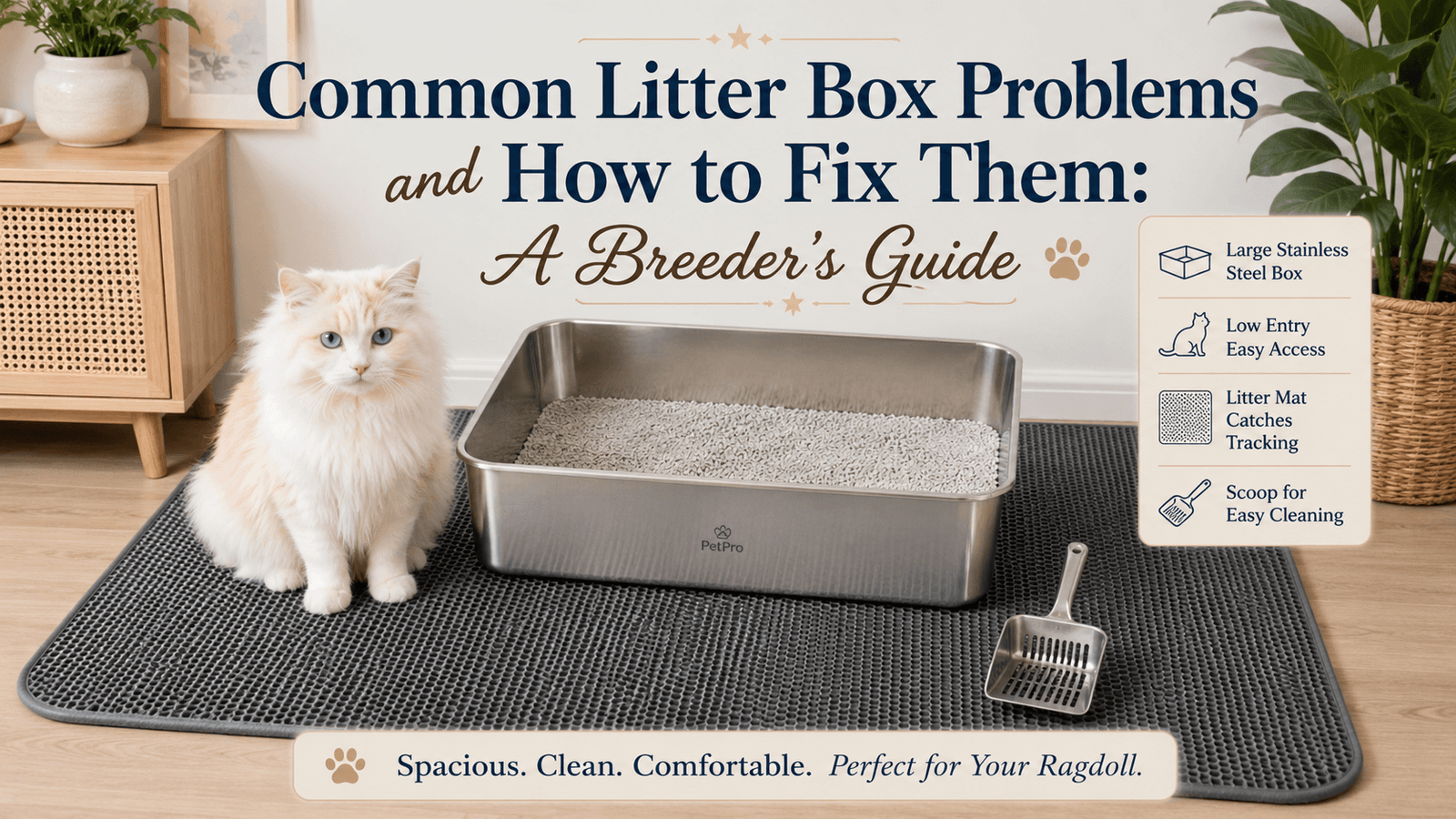
Common Litter Box Problems and How to Fix Them: A Breeder’s Guide
If you’ve never had a litter box problem, count yourself lucky — and don’t get too comfortable. Most cat owners deal with at least one litter box issue at some point, and many deal with several over the course of their cat’s life.
This guide covers the most common litter box problems we hear about from our adopters and from cat owners generally — what causes each one, and exactly how to fix it. For the deeper dives on peeing or pooping outside the box specifically, see our companion posts:
Problem 1: Litter Tracking All Over the House
You walk barefoot through the kitchen and step on a piece of litter. Five rooms away from the box. Sound familiar?
Causes:
- Lightweight or dusty litter (clay litter is the worst offender)
- Cat hopping straight out without pausing on the edge
- Box placed on smooth flooring with no transition
- Long-haired cat (paw fur catches and carries litter)
Fixes:
- Switch to Cat Butler Pea-Based Litter — the pellets are heavier than clay dust and track significantly less. Plus they’re safe if your cat ingests them during grooming.
- Use a litter mat — honeycomb-style mats trap litter from paws as cats step out. Place one directly outside the box.
- Trim the fur between toe pads — for long-haired cats like Ragdolls, the tufts of fur catch litter. Trim them flush with the pads using rounded-tip scissors.
- Use a top-entry box or higher walls — only if your cat tolerates it. Most prefer open boxes, but a deeper box with high sides keeps more litter contained.
🎉 Get 20% Off Cat Butler Litter
As a Kitten Around Ragdolls reader, you can get 20% off your first order at Cat Butler.
Use code: kittenaroundragdolls20
Problem 2: Kicking Litter Everywhere
Some cats dig with theatrical enthusiasm — sending litter flying out of the box in all directions.
Causes:
- Box is too small or too shallow
- Litter level is too low (they’re digging trying to find more)
- Pure personality — some cats are just enthusiastic diggers
Fixes:
- Get a bigger box. Aim for at least 28″ × 20″ with walls between 12″ and 19″ tall. Stainless steel is non-porous and won’t absorb odor or bacteria like plastic does. For most diggers, our open-top stainless steel box is enough. For serious kickers or high pee-ers, get the covered stainless steel version with higher walls.
- Increase litter depth to 3-4 inches. Cats kick more when there isn’t enough to dig in.
- Use a box with high walls on three sides. Look for boxes with one lower entry side and three taller walls to contain kicked litter.
- Don’t switch to a covered box just to contain mess if your cat doesn’t tolerate covers. Some cats refuse covered boxes — you’ll trade one problem for another. Try the high-walled open-top first.
Problem 3: Strong Odor Even With Daily Scooping
You’re scooping every day and the room still smells. What gives?
Causes:
- Litter type doesn’t have enough odor control
- Box itself has absorbed odor over time (a major issue with plastic boxes)
- Full litter change is overdue
- Underlying medical issue making urine extra pungent (FLUTD, kidney issues, diabetes)
Fixes:
- Switch to a high-quality clumping litter with natural odor control. Pea-based litter handles odor naturally without added perfume.
- If you have plastic boxes, switch to stainless steel. Plastic is porous — it absorbs urine, ammonia, and bacteria into the surface and into the scratches cats create when digging. No amount of cleaning fixes a plastic box that’s been used for years. Stainless steel is non-porous and won’t absorb odor at all. We recommend at least 28″ × 20″ with walls between 12-19″ tall. See the open-top box we recommend or the covered version for maximum odor and mess containment.
- Do a full litter change every 2-4 weeks. Even with daily scooping, urine penetrates to the bottom over time.
- Skip scented litters and air fresheners. The perfume often makes things worse, not better — and your cat may stop using a heavily scented box.
- If odor is suddenly stronger: see a vet. Very strong-smelling urine can be a sign of UTI, FLUTD, kidney disease, or diabetes.
Problem 4: Cat Won’t Use the Box at All
This is the scariest problem because it can mean a few different things.
Causes:
- Medical issue (UTI, FLUTD, blockage — emergency!)
- Box is too dirty, too small, or in a bad location
- Wrong litter type
- Stress or environmental change
- Negative association (was scared/hurt in the box and won’t go back)
Fixes:
- See a vet first. Always. Roughly half of “behavioral” box refusal turns out to be medical.
- Audit the basics: N+1 rule, 24+ inch box, scooped daily, quiet location, away from food.
- Try a different litter type. If your cat is refusing, the litter is suspect. Pea-based is well-tolerated by nearly every cat.
- Add a second box in a new location. Sometimes a fresh setup in a new spot is all it takes.
- Address stress sources. Recent move, new pet, new baby, schedule change — any of these can trigger refusal.
Problem 5: Cat Pees and Poops in Different Boxes
Some cats are particular: they pee in one box and poop in another. This drives some owners crazy, but it’s actually normal cat behavior.
Causes:
- Natural cat preference — many cats simply prefer separate “rooms” for different functions
- Box too small for both activities in one
- Cat doesn’t want to use a box that already has waste in it
Fixes:
- Don’t fight it — accommodate it. Provide enough boxes (N+1 minimum) and they’ll self-organize.
- Make sure boxes are big enough that they could do both in one if they chose to.
- Scoop frequently. Some cats refuse to use a box that already has anything in it.
Problem 6: One Cat Is Blocking the Box
In multi-cat homes, one cat may “guard” the box — sitting near it, blocking entry, or ambushing other cats as they leave.
Causes:
- Inter-cat tension or hierarchy struggles
- Not enough boxes (forces sharing)
- Boxes clustered in one area (one cat can monitor all of them)
Fixes:
- Apply N+1 strictly. Three cats = four boxes. No exceptions.
- Spread boxes across the house. Different rooms, different floors. No cat can guard them all.
- Add vertical territory. Cat trees, shelves, and window perches reduce ground-level conflict.
- Use Feliway MultiCat. The pheromone diffuser is designed for multi-cat tension specifically. Find Feliway on our Amazon storefront.
Problem 7: Cat Eats the Litter
Some cats — especially kittens — will eat litter. It’s usually a passing curiosity, but sometimes it indicates a nutritional deficiency or medical issue.
Causes:
- Normal kitten exploration
- Pica (compulsive eating of non-food items)
- Anemia or nutritional deficiency
- Stress
Fixes:
- Use safe litter from the start. This is the single biggest argument for pea-based litter — if your kitten eats some, it passes safely. Clay-based litter can form blockages.
- See a vet if the behavior continues past kitten-hood or is excessive. They can check for anemia and other deficiencies.
- Make sure they’re eating enough quality food. A nutritionally complete diet usually resolves the urge.
Problem 8: Box Is Suddenly Smelling Like Ammonia
Ammonia is a normal byproduct of urine breakdown, but if the smell is overwhelming, something’s off.
Causes:
- Box not being changed frequently enough
- Cat is more dehydrated than usual (more concentrated urine)
- Medical issue (UTI, kidney disease)
Fixes:
- Do a full litter change and wash the box. If you can’t remember when you last did this, it’s overdue.
- Increase your cat’s water intake. Add wet food, use a water fountain, place water bowls in multiple locations.
- See a vet if the issue persists. Strong ammonia smell can indicate concentrated urine from kidney issues or dehydration.
Problem 9: Kitten Won’t Use the Box Reliably
New kittens are still learning, and accidents are normal in the first few weeks home.
Causes:
- Box is too tall to enter easily
- Kitten doesn’t know where the box is in the new home
- Stress from the transition
- Different litter than they’re used to
Fixes:
- Use a low-entry box for the first month. A baking sheet or shallow stainless steel tray works while they’re growing into a full-size XXL box.
- Confine them initially. Keep kittens in one room with their box, food, water, and bedding for the first few days. As they get comfortable, expand their territory.
- Place the kitten in the box after meals and naps. Their natural rhythm makes these the times they’re most likely to need to go.
- Use the same litter they’re used to. Our kittens go home with Cat Butler — keep using it for a smooth transition.
When to See a Vet
Get to a vet right away if you see any of these alongside litter box issues:
- Straining without producing urine — possible blockage (life-threatening in males)
- Blood in urine or stool
- Crying or vocalizing in the box
- Lethargy, hiding, or loss of appetite
- Vomiting plus litter box changes
- Sudden total refusal in a previously well-trained cat
Final Thoughts
Most litter box problems come down to one of three things: a medical issue, a setup issue, or a stress issue. Work through them in that order — vet first, setup audit second, environmental review third — and you’ll resolve the vast majority of problems within a few weeks.
If you’ve adopted a Ragdoll from us and you’re working through any of these, reach out. We’ve helped many of our adopters troubleshoot litter box issues, and lifetime breeder support is part of what we offer.
🛒 Shop Our Recommendations
Litter mats, scoops, Feliway diffusers, enzymatic cleaners — everything we recommend for a clean, happy litter box setup.
Disclosure: This post contains affiliate links to our Amazon storefront. As an Amazon Associate, we earn from qualifying purchases at no extra cost to you. We only recommend products we personally use and trust with our own cats and kittens.
Looking to bring home a Ragdoll kitten? Check our available kittens or join our waitlist for upcoming litters. We’re a TICA-registered cattery in Sacramento, CA, breeding for health, temperament, and the traditional Ragdoll standard.
Recent Blogs
05/27/2026
Why Is My Cat Pooping Outside the Litter Box? A Troubleshooting Guide
05/25/2026
The Best Litter Box Setup for Ragdolls (Size, Number, Location & Litter Type)

05/16/2026
Why Is My Cat Peeing Outside the Litter Box? Causes and Solutions
05/13/2026
What Is an Ethical Ragdoll Cat Breeder? Breeding to the Standard Explained

05/09/2026