The Best Litter Box Setup for Ragdolls (Size, Number, Location & Litter Type)
If you’ve ever wondered whether your Ragdoll’s litter box situation is “good enough,” the answer is almost certainly: it could be better. Most pet store litter boxes are too small for any adult cat — and they’re definitely too small for a 15-20 pound Ragdoll. Add in cramped locations, the wrong litter type, or not enough boxes for a multi-cat home, and you’ve got a recipe for litter box problems.
The good news: getting the setup right is mostly cheap and easy. In this guide, we’ll walk through exactly how we set up litter boxes in our cattery — and how we recommend our adopters set them up at home.
Size: Bigger Is Always Better
Ragdolls are a big breed. Males commonly reach 15-20 pounds, females 10-15 pounds, and they don’t fully mature until age 4. A box that fit them as a kitten will be embarrassingly small by the time they’re 2 years old.
Most “jumbo” boxes sold at pet stores top out around 22 inches — not big enough for a full-grown Ragdoll.
Our Litter Box Requirements for Ragdolls:
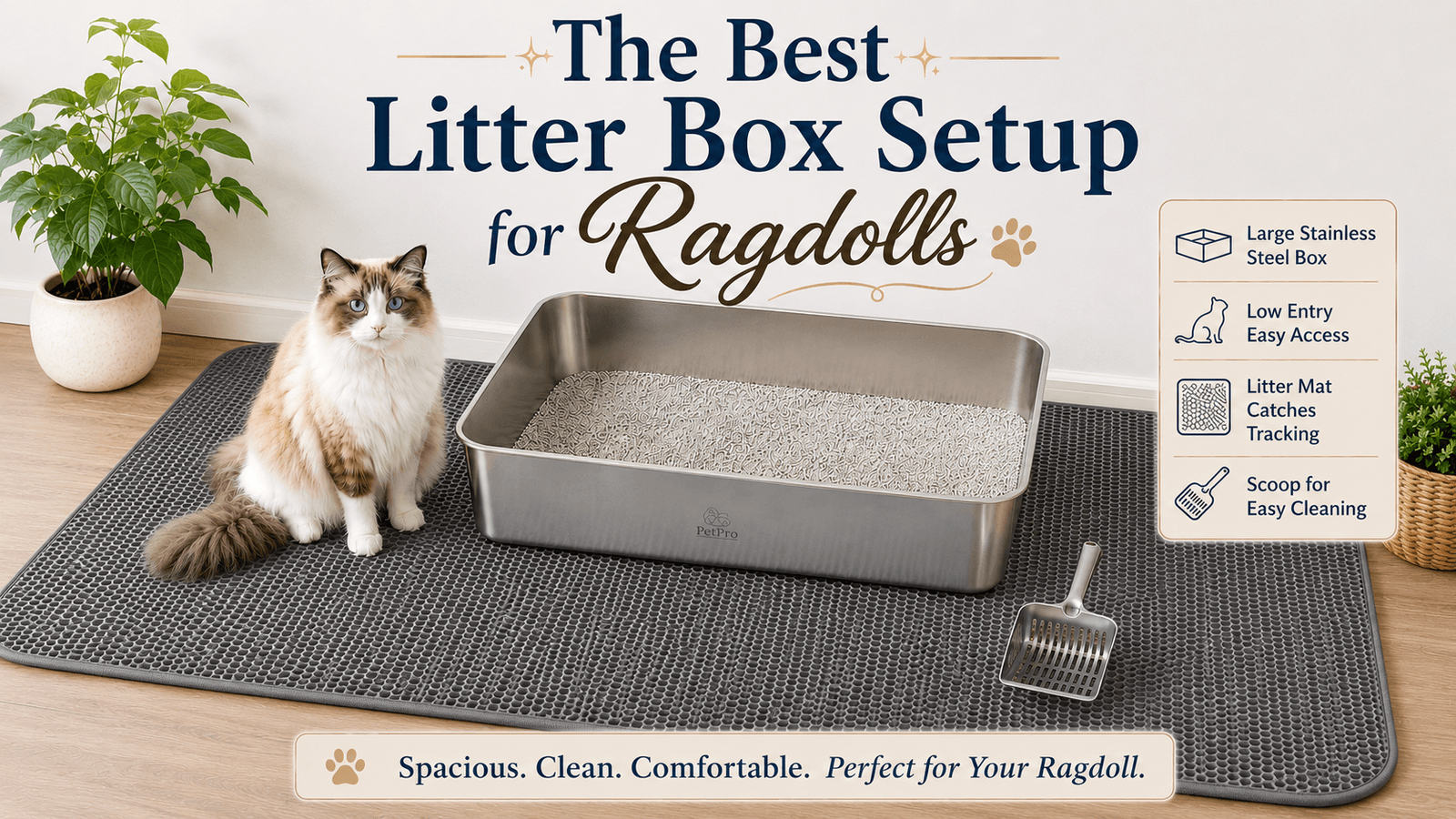
- At least 28″ × 20″ footprint — gives your Ragdoll room to turn around, dig, posture, and bury without hanging off the edge
- Minimum 12″ wall height — contains kicked litter and prevents urine from spilling over the sides
- Maximum 19″ wall height — beyond this, even adult Ragdolls struggle to enter comfortably
- Stainless steel construction — non-negotiable for hygiene reasons (see next section)
Our Recommended Boxes
Here are the two boxes we use and recommend:
- Open-top stainless steel box — our standard pick. Spacious, high enough walls to contain mess, low enough entry for easy access. Shop the open-top XXL stainless steel box on Amazon.
- Covered stainless steel box — for high pee-ers, enthusiastic diggers, or households where you need maximum mess containment. The high walls catch everything. Shop the covered XXL stainless steel box on Amazon.
Either one works well for Ragdolls. We typically use the open-top in most areas of the cattery and the covered version for boys who pee high or really enthusiastic diggers.
Material Matters: Why We Use Stainless Steel
In our cattery, we use stainless steel litter boxes exclusively — and we never recommend plastic boxes, no matter how large or fancy. Here’s why:
- Plastic is porous. Even when it looks clean, plastic absorbs urine, ammonia, and bacteria into the surface. Over time, your box smells permanently — and no amount of scrubbing fixes it.
- Cats scratch plastic. Every time your cat digs, they’re creating microscopic scratches in the plastic surface. Those scratches harbor bacteria, retain odor, and grow worse with every use.
- Stainless steel is non-porous. It doesn’t absorb anything. No odor retention, no bacteria buildup, no permanent staining.
- Stainless is easy to disinfect. You can hit it with hot water, OdoBan, Rescue, or any veterinary-grade cleaner without worrying about it degrading. Plastic can warp or absorb cleaning chemicals.
- Stainless lasts forever. A quality stainless box is a buy-it-for-life item. Plastic boxes need replacing every 1-2 years.
- It’s healthier. In a multi-cat home or a breeding environment, the difference in infection control between stainless and plastic is significant.
Yes, stainless steel boxes cost more upfront — but you’ll never buy another box, you won’t fight permanent odor, and your cat gets a cleaner, more hygienic bathroom for life.
For kittens or senior cats with mobility issues, look for stainless boxes with a lower entry side, or get a temporary low-entry option for the transition period before they can comfortably enter a full-size box.
Number of Boxes: The N+1 Rule
The veterinary and behavioral standard is simple: one box per cat, plus one extra.
- 1 cat = 2 boxes
- 2 cats = 3 boxes
- 3 cats = 4 boxes
And critically: boxes need to be in different locations. Two boxes sitting side-by-side count as one in a cat’s mind. The whole point of having multiple boxes is so a cat can always reach one without being blocked, ambushed, or having to share with a dominant housemate.
People often resist the N+1 rule because it means more cleanup. But more boxes actually means less total mess — because cats consistently use them and don’t go outside the box. One extra scoop a day is way easier than enzymatic-cleaning the carpet weekly.
Open vs. Covered: Always Open
Covered boxes are sold for human convenience — they trap odor and contain stray litter scatter. But from your cat’s perspective, they’re awful:
- Odor trap: what feels “contained” to you smells overwhelming to your cat (their nose is 14x more sensitive)
- Movement restriction: Ragdolls especially have trouble posturing and turning in a covered box
- Vulnerability: cats want to see approaching threats while they’re in a vulnerable position
- Ambush risk: in multi-cat homes, the box becomes a trap where one cat can corner another
If you currently have a covered box and your cat uses it without issues, you don’t have to change anything. But if you’re seeing inappropriate elimination, take the lid off for two weeks and see what happens. Most cats prefer open boxes once given the choice.
Location: Quiet, Safe, Accessible
Where you put the boxes matters as much as what kind of boxes they are. Cats want their bathroom to be:
- Quiet — away from washers, dryers, water heaters, and noisy foot traffic
- Safe — with sightlines to spot approaching threats, not tucked into a corner with no escape
- Accessible — easy to reach without climbing stairs (especially for kittens and seniors)
- Separate from food — cats won’t toilet where they eat
- Private but not isolated — they want a calm spot, not the back of a closet that occasionally gets shut
For multi-level homes, place at least one box on each floor. Cats with diarrhea, urinary urgency, or arthritis may not make it across the house and up stairs in time.
Litter Type: Why We Use Pea-Based
The litter itself is one of the most important — and most controversial — choices you’ll make. Our position is straightforward: we only use and recommend Cat Butler Pea-Based Clumping Cat Litter.
Why pea-based:
- Safe if ingested — kittens groom themselves constantly and inevitably swallow some litter. Pea husk passes harmlessly through the digestive tract.
- 99.9% dust-free — better for both your cat’s lungs and your air quality
- Low-tracking — pea pellets are heavier than clay dust, so less ends up on your floors
- Strong clumping — clumps stay together for easy scooping
- Natural odor control — no perfume needed
- Biodegradable — environmentally responsible
🎉 Get 20% Off Cat Butler Litter
As a Kitten Around Ragdolls reader, you can get 20% off your first order at Cat Butler.
Use code: kittenaroundragdolls20
What to Avoid
Other litters we don’t recommend:
- Crystal/silica gel — sharp edges can damage paws and the digestive tract
- Pine pellets — texture is too rough for many cats; some refuse to use it
- Scented litter (any base) — perfume is overwhelming to a cat’s sensitive nose
- “Lightweight” clay — even more dust than regular clay
Depth of Litter
Aim for 3-4 inches of litter in the box. Less than that and clumps stick to the bottom; more than that and your cat will track it everywhere and waste litter when scooping.
Refill as needed to maintain that depth, and do a full litter change + box wash every 2-4 weeks.
Accessories That Make Life Easier
A few extras that genuinely help:
- Litter mat — placed in front of the box, catches tracked litter before it spreads through your house. The honeycomb-style mats work best.
- Metal scoop — sturdier than plastic, won’t bend or break, lasts forever
- Lidded waste pail — keeps scooped waste contained until trash day. A diaper genie works perfectly.
- Enzymatic cleaner — for the inevitable accident outside the box. We swear by Biokleen Bac-Out.
Find all of our recommended litter box accessories on our Amazon storefront.
Cleaning Routine
The single biggest factor in whether your cat uses the box is how clean it is. Our routine:
- Daily: scoop solids and clumped urine (twice a day in multi-cat homes)
- Weekly: wipe box edges, refill litter to 3-4 inch depth
- Every 2-4 weeks: dump all litter, wash box with hot water and a non-toxic disinfectant (we use OdoBan), dry thoroughly, refill with fresh litter
- As needed: deep disinfect with veterinary-grade cleaner like Rescue (Virox AHP) if a cat in the household has been sick, or anytime you want a full sanitization
This is another reason stainless steel matters: you can hit it with serious disinfectants like Rescue without worrying about chemical absorption or surface degradation. With plastic, you’re limited in what you can safely use — and even then, it absorbs odor permanently over time.
Skip bleach and ammonia-based cleaners. Bleach can create dangerous fumes when mixed with urine, and ammonia smells like cat urine to a cat — both can make litter box problems worse.
Setup for Multi-Cat Households
If you have multiple cats, the N+1 rule isn’t optional — it’s the foundation of a peaceful home. A few additional tips:
- Spread boxes across the house so no single cat can guard all of them
- Provide vertical territory (cat trees, shelves) so cats can de-stress through climbing
- Use Feliway MultiCat diffusers in rooms where tension is highest
- Monitor whether one cat is monopolizing a box and consider adding another
Setup for Kittens
If you’re bringing home a new kitten from us — or anywhere — make their setup as easy as possible for the first few weeks:
- Low-entry box: something they can step into easily (a baking sheet or a shallow stainless steel tray works for the first few weeks)
- Same litter we use: we send our kittens home with a sample of Cat Butler so their litter doesn’t change in the move
- Multiple boxes available: even just one kitten benefits from 2 boxes, especially in the first month
- Easy access: if you’re confining them to one room initially, put the box on the opposite side from food and water
Final Thoughts
Getting the litter box setup right isn’t complicated, but it’s one of the most important things you can do for a happy household. The right size, the right number, the right location, and the right litter prevent the vast majority of inappropriate elimination problems before they ever start.
If you’ve recently brought home a Ragdoll from us and want help dialing in your setup, reach out — lifetime breeder support is part of what we offer.
🛒 Shop Our Recommendations
Litter boxes, mats, scoops, enzymatic cleaners, Feliway diffusers — everything we recommend, all in one place.
Disclosure: This post contains affiliate links to our Amazon storefront. As an Amazon Associate, we earn from qualifying purchases at no extra cost to you. We only recommend products we personally use and trust with our own cats and kittens.
Looking to bring home a Ragdoll kitten? Check our available kittens or join our waitlist for upcoming litters. We’re a TICA-registered cattery in Sacramento, CA, breeding for health, temperament, and the traditional Ragdoll standard.
Recent Blogs
05/16/2026
Why Is My Cat Peeing Outside the Litter Box? Causes and Solutions
05/13/2026
What Is an Ethical Ragdoll Cat Breeder? Breeding to the Standard Explained

05/09/2026
What Should I Feed My Ragdoll? A Complete Feeding Guide from Kitten to Adult
05/06/2026
Ragdoll Cat Personality Traits – Is This the Right Breed for You?
05/02/2026