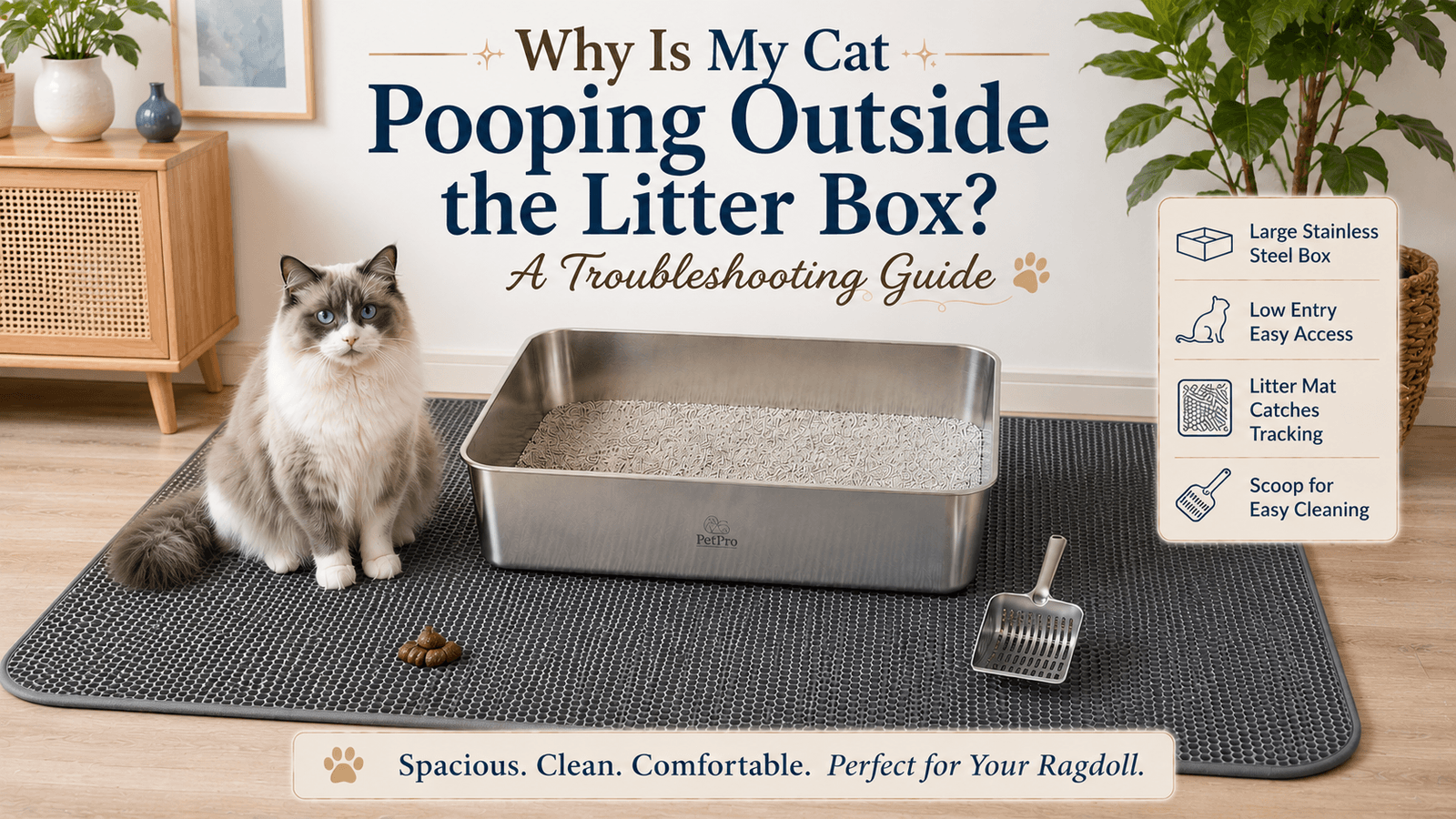
Why Is My Cat Pooping Outside the Litter Box? A Troubleshooting Guide
Finding cat poop on the floor is no one’s idea of a good morning. And unlike inappropriate urination — which often gets attention because of the strong smell and stains — pooping outside the box can sometimes go on for weeks before owners realize it’s becoming a pattern.
The good news: cats almost never poop outside the box randomly. They’re telling you something — about their health, their environment, or the litter box setup itself. This guide walks you through how to figure out what’s going on and exactly how to fix it.
If your cat is also peeing outside the box, you’ll want to read our companion post: Why Is My Cat Peeing Outside the Litter Box? The causes overlap but aren’t identical, and the solutions are different.
Step 1: Look at the Poop Itself
Before you do anything else, look at what’s coming out. Cat poop is one of the most useful diagnostic tools you have, and the consistency, color, and frequency tell you a lot about what’s going on.
Healthy Cat Poop Should Be:
- Brown (medium to dark)
- Formed but not hard — like a tootsie roll, not pebbles or a puddle
- Produced 1–2 times per day for adult cats (kittens may go more often)
- Not overly smelly — yes, it smells, but extreme odor often signals digestive issues
Warning Signs in the Poop:
| What You See | What It Might Mean |
|---|---|
| Hard, dry pebbles | Constipation or dehydration |
| Soft serve / pudding consistency | Mild digestive upset, food intolerance |
| Watery diarrhea | Infection, food allergy, parasites, or stress |
| Blood (red streaks or dark/tarry) | Inflammation, parasites, or GI bleeding — see vet |
| Mucus coating | Colon inflammation or parasites |
| White specks (rice-like) | Tapeworms — see vet |
| Pale or clay-colored | Liver or pancreatic issues — see vet immediately |
| Black and tarry | Upper GI bleeding — see vet immediately |
Take a photo of any abnormal poop before you clean it up. Your vet will appreciate it, and it gives you a record if the issue keeps happening.
Step 2: Rule Out Medical Causes
Just like with peeing problems, medical issues are the #1 cause of sudden changes in litter box behavior. Get your cat to the vet before you assume it’s behavioral.
Constipation
This is one of the most overlooked causes. A constipated cat will strain in the box, get frustrated, and then go somewhere else hoping it’ll be easier. They may also associate the box with the pain of straining and start avoiding it altogether.
Signs of constipation:
- Straining in the box but producing little or nothing
- Hard, dry, pellet-like stools
- Going several days without pooping
- Vomiting (especially after eating)
- Lethargy or hiding
Causes include dehydration, low-fiber diet, hairballs blocking the colon, obesity, and arthritis (which makes it painful to posture in the box). Long-haired breeds like Ragdolls are especially prone to hairball-related constipation.
Diarrhea
On the opposite end, a cat with diarrhea may not be able to make it to the box in time — especially if the box is far away or up/down stairs. They’re not “misbehaving”; their bodies are giving them no warning.
Common causes of diarrhea in cats:
- Sudden food changes (always transition over 7–10 days)
- Food intolerance or allergy (often grain or chicken-related)
- Intestinal parasites (worms, giardia, coccidia)
- Bacterial or viral infections
- Stress (yes, stress causes diarrhea in cats just like humans)
- Inflammatory bowel disease (IBD)
- Hyperthyroidism (in older cats)
Inflammatory Bowel Disease (IBD)
IBD is increasingly common in cats and causes chronic, intermittent digestive issues — sometimes constipation, sometimes diarrhea, sometimes both. It often presents as a cat who’s been “fine” for years suddenly developing inconsistent litter box habits.
IBD requires veterinary diagnosis (usually via biopsy) and lifelong management with diet, medication, or both.
Arthritis or Joint Pain
An older or overweight cat may avoid the box because climbing in or squatting hurts. If your senior cat has high-sided boxes or boxes located up stairs, joint pain could be the issue. Try a lower-entry box and see if the behavior changes.
Anal Gland Issues
Cats have anal glands that can become impacted, infected, or inflamed. When this happens, defecating is painful, and the cat may try to escape the pain by going somewhere new. Signs include scooting on the floor, excessive licking under the tail, and a foul fishy odor. A vet can express the glands and treat any infection.
Parasites
Worms, giardia, and coccidia all cause digestive upset and inappropriate defecation. If your cat has had any exposure to other animals, outdoor access, or a new kitten in the household, ask your vet to run a fecal test. Some parasites also cause weight loss, dull coat, or pot-bellied appearance.
Bottom line: Vet first. Always.
Step 3: Litter Box Issues
If medical causes are ruled out, the box itself is the next place to look. Cats are extremely particular about where they poop — sometimes even more particular than where they pee.
The Box Isn’t Clean Enough
Cats won’t poop in a box that already has poop in it. Ever scooped your box thinking “this is fine for now” only to find a fresh deposit on the rug an hour later? That’s why.
Standards:
- Scoop at least once daily, ideally twice — especially in multi-cat homes
- Full litter change and box wash every 2–4 weeks with hot water and a non-toxic disinfectant like OdoBan (skip bleach and ammonia — both can attract cats back to inappropriate spots)
The Box Is Too Small (or Made of the Wrong Material)
Most pet store litter boxes are too small for any adult cat — and definitely too small for a Ragdoll. A 15–20 lb male needs serious room to turn, dig, posture, and bury without hanging off the edge.
We use stainless steel litter boxes in our cattery — never plastic. Plastic absorbs urine, ammonia, and bacteria into the surface, and cats’ scratching creates microscopic grooves that harbor germs. Stainless is non-porous, easy to disinfect, and lasts forever.
For Ragdolls, we recommend a box that’s at least 28″ × 20″ with walls between 12 and 19 inches tall. Our two picks: the open-top stainless steel box for most cats, or the covered version for high pee-ers and enthusiastic diggers.
The Box Is Covered (When Your Cat Doesn’t Like It)
Some cats love a covered box; others hate them. Covered boxes can trap odor, restrict your cat’s ability to posture comfortably, and prevent them from seeing approaching threats. Pooping is a vulnerable position — many cats want a clear line of sight.
If your cat is pooping outside a covered box, take the lid off for two weeks and see what happens. If they start using it again, they were telling you something.
The Wrong Litter
Cats have strong preferences about what’s under their paws. If you recently switched litter brands or types, that’s likely your culprit. Some cats will pee in a new litter but refuse to poop in it because pooping requires a longer squat and more contact with the substrate.
Our recommendation: Cat Butler Pea-Based Clumping Cat Litter. This is the only litter we use in our cattery. It’s made from natural pea husk — biodegradable, low-tracking, 99.9% dust-free, and safe if your cat ingests some during grooming. Most cats accept it without issue, and the soft texture is comfortable for the longer squat that defecation requires.
🎉 Get 20% Off Cat Butler Litter
As a Kitten Around Ragdolls reader, you can get 20% off your first order at Cat Butler.
Use code: kittenaroundragdolls20
Not Enough Boxes
The standard rule: one box per cat, plus one extra, in different locations. So one cat = two boxes, two cats = three boxes, and so on. If you have a multi-floor home, put boxes on each floor.
If you only have one box for multiple cats, the lower-status cat may avoid the box entirely after the dominant cat uses it. They’re not punishing you — they’re avoiding what they perceive as “marked” territory.
Wrong Box Location
Cats want their bathroom in a quiet, low-traffic, safe-feeling area — but not so isolated that they have to travel far to reach it. Common location mistakes:
- Next to noisy appliances (washer, dryer, water heater) — sudden noises spook cats mid-poop
- In a closet that sometimes closes — they get locked out
- Near food and water — cats won’t poop where they eat
- Only in basement or upstairs — a cat with diarrhea or arthritis may not make it
- In a busy hallway or main living area — they want privacy, not an audience
Step 4: Diet and Digestive Health
For poop problems specifically, what your cat eats matters even more than for pee problems. Diet directly affects stool consistency, frequency, and the cat’s ability to comfortably make it to the box.
Sudden Food Changes
This is the most common dietary cause we see. Switching food too quickly causes digestive upset that can result in either diarrhea or constipation — both of which can drive your cat out of the box.
Always transition food over 7–10 days: 75% old / 25% new for a few days, then 50/50, then 25/75, then full switch. If you’re not sure what food is best for your Ragdoll, see our complete feeding guide.
Food Intolerance or Allergy
If your cat has chronic soft stools or intermittent diarrhea, they may be reacting to something in their food. Common culprits:
- Grain (corn, wheat, soy)
- Chicken (yes, really — even though it’s the most common cat food protein)
- Beef
- Fish (some cats develop allergies to this over time)
- Dairy
- Artificial colors and preservatives
An elimination diet (working with your vet) is the only reliable way to identify a food allergy. Don’t randomly start switching foods — that just stresses the gut more.
Not Enough Moisture
Dehydration is a leading cause of constipation in cats. If your cat eats only dry food, their stool will be drier and harder. Adding wet food or rehydrated freeze-dried food (like Fresh Is Best) significantly improves stool quality and reduces straining.
Hairballs
Long-haired cats like Ragdolls swallow a lot of hair during grooming. Most of it passes through, but sometimes it can build up in the colon and cause constipation. Regular brushing (we recommend daily for Ragdolls) and a small amount of hairball remedy paste can help. Pumpkin puree (plain, no spices) is also a good fiber boost — about 1 teaspoon mixed into wet food.
Step 5: Stress and Behavioral Causes
Stress is a huge driver of inappropriate defecation, and cats are stressed by things humans don’t even register.
Recent Changes
Common stress triggers include:
- Moving to a new home
- New baby, partner, or roommate
- New pet (cat, dog, or other)
- Construction or renovation
- A regular family member leaving
- Schedule changes
- Even rearranging furniture
Stress-related pooping outside the box is often called “middening” — and cats may deliberately leave poop in visible spots (the middle of a bed, the top of laundry) as a territorial marking behavior. It’s not spite; it’s anxiety.
Multi-Cat Tension
Even cats who seem to coexist peacefully can have undercurrents of conflict. The lower-status cat may be ambushed in or near the box and stop using it. Solutions: more boxes (the N+1 rule), boxes in separate rooms, and addressing underlying tension with Feliway diffusers and additional vertical space (cat trees, shelves).
Calming Aids
For anxiety-related issues, calming aids can help significantly:
- Feliway diffusers — synthetic facial pheromones that signal “this place is safe.” We keep these running in our cattery for any new kitten transition. Find Feliway on our Amazon storefront.
- Calming treats and supplements — L-theanine, alpha-casozepine, or Zylkene
- Vet-prescribed medication — for severe cases, ask about gabapentin or fluoxetine
How to Clean Up After Inappropriate Defecation
Like with urine, you must fully eliminate the smell or your cat will return to the same spot. Their nose is far more sensitive than yours.
Use an enzymatic cleaner — the enzymes break down organic matter at a molecular level instead of just covering up the smell. Skip regular cleaners, vinegar, and especially bleach (which can attract cats back).
Our top picks for cleaning up cat accidents:
- Biokleen Bac-Out — live enzyme cultures that actually break down urine and feces proteins. Plant-based, light scent, works better than anything else we’ve tried.
- OdoBan — daily-driver disinfectant. We use the concentrate diluted for floors and surfaces. Cat-safe and incredibly cost-effective.
- Rescue (Virox) — veterinary-grade disinfectant for deep cleaning. Kills parvo, ringworm, and pretty much anything else. Fragrance-free and animal-safe.
Browse our cleanup essentials on our Amazon storefront. We’ve tested most of the popular alternatives — Nature’s Miracle, Rocco & Roxie, Scout’s Honor — and these three consistently outperform them.
Cleaning steps:
- Pick up solid waste with a paper towel
- Spray the area thoroughly with enzymatic cleaner
- Let it sit per the bottle’s instructions (usually 10–30 minutes)
- Blot — don’t rinse
- For carpet, mattresses, or upholstery, you may need to repeat 2–3 times
- Use a UV blacklight at night to find spots you missed
What NOT to Do
- Don’t punish your cat. Yelling, rubbing their nose in it, or spraying water makes them anxious — and stress causes more litter box issues, not fewer.
- Don’t ignore it. The longer it goes on, the more it becomes habit. Address it within days.
- Don’t assume it’s “bad behavior.” Cats don’t think that way. They’re communicating a problem.
- Don’t switch foods without a plan. Random food switching makes digestive issues worse.
- Don’t skip the vet visit. Half of “behavioral” poop problems turn out to be medical.
When to See a Vet Immediately
Some symptoms can’t wait. Get to a vet (or emergency clinic) right away if you see:
- Blood in the stool — fresh red or dark/tarry
- Vomiting plus diarrhea (dehydration risk is high)
- No bowel movement for 3+ days
- Straining with no production
- Lethargy, hiding, or loss of appetite alongside the issue
- A pot-bellied appearance, especially in kittens
- Worms or anything moving in the stool
Final Thoughts
Pooping outside the box is frustrating, but it’s almost always solvable once you identify the cause. Start with a vet visit and a stool sample. Audit the litter box setup. Look at what your cat is eating. Address any environmental stress. Most cases resolve within 2–4 weeks once the root cause is fixed.
If you’ve adopted a Ragdoll from us and you’re dealing with this issue, reach out. Lifetime breeder support is one of the things we offer, and we’ve helped many of our adopters troubleshoot litter box problems over the years.
🛒 Shop Our Recommendations
Stainless steel litter boxes, enzymatic cleaners, Feliway diffusers, and everything else we recommend in this post — all curated on one storefront.
Disclosure: This post contains affiliate links to our Amazon storefront. As an Amazon Associate, we earn from qualifying purchases at no extra cost to you. We only recommend products we personally use and trust with our own cats and kittens.
Looking to bring home a Ragdoll kitten? Check our available kittens or join our waitlist for upcoming litters. We’re a TICA-registered cattery in Sacramento, CA, breeding for health, temperament, and the traditional Ragdoll standard.
Recent Blogs
05/25/2026
The Best Litter Box Setup for Ragdolls (Size, Number, Location & Litter Type)
05/16/2026
Why Is My Cat Peeing Outside the Litter Box? Causes and Solutions
05/13/2026
What Is an Ethical Ragdoll Cat Breeder? Breeding to the Standard Explained

05/09/2026
What Should I Feed My Ragdoll? A Complete Feeding Guide from Kitten to Adult
05/06/2026